ABLE to feel feelings
On TikTok recently, I’ve noticed that in the comments of emotion or mental health posts, people are asking how to feel their feelings. The questions are earnest, and imply that people understand the importance of feeling feelings but they don’t actually know how. It makes sense—the people who are giving the advice to “feel your feelings” already know how, which means the statement is basically incomprehensible, like it’s in a different language. So HOW—with practical, actionable steps—can someone learn to feel their feelings? HOW can someone learn the language of emotions?
Based on my knowledge of emotion science, I’ve put together four key components to being able to feel feelings, and given them the acronym of ABLE.
ABLE stands for Aware, Body, Label, Explore.
You need to be Aware an emotional experience is happening, attend to where that feeling is located in your Body, give the feeling a Label (i.e., name it), and the Explore what the feeling is trying to tell you. If you do these things, you will feel that feeling.
I want to be crystal clear here. These are steps to follow in a moment of time when you want to feel your feelings, but if you’re someone who isn’t used to feeling your feelings, you won’t be able to follow these steps right away. You will need to train up each step. Otherwise you can’t speak the language. Knowing the acronym won’t give you sudden skills, just like you can’t speak Norwegian without practicing.
Let’s go through the basics of being ABLE to feel feelings. (Note: my book, Open to Emotion, goes through these in much more detail. There are separate chapters on Aware [which includes awareness of Body sensations], Label, and Explore with exercises and explanations in each one).
A is for Aware.
Being able to tune into the small fluctuations in your affective experience matters. Note that I’m referring to “affect” here—affect refers to the degree of pleasantness and activation that you can tune into at any moment. At any moment, you can rate pleasantness from 0 to 10 [insert here] where 0 is very unpleasant and 10 is extremely pleasant. At the same time, you can also rate the degree of activation you feel where 0 is sluggish, sleepy, and 10 is jazzed, pumped, tense. Putting those together you might think of a grid, where at any moment in time you could rate where you are at. A very strong pleasant emotion might be in the top right hand corner, for example.
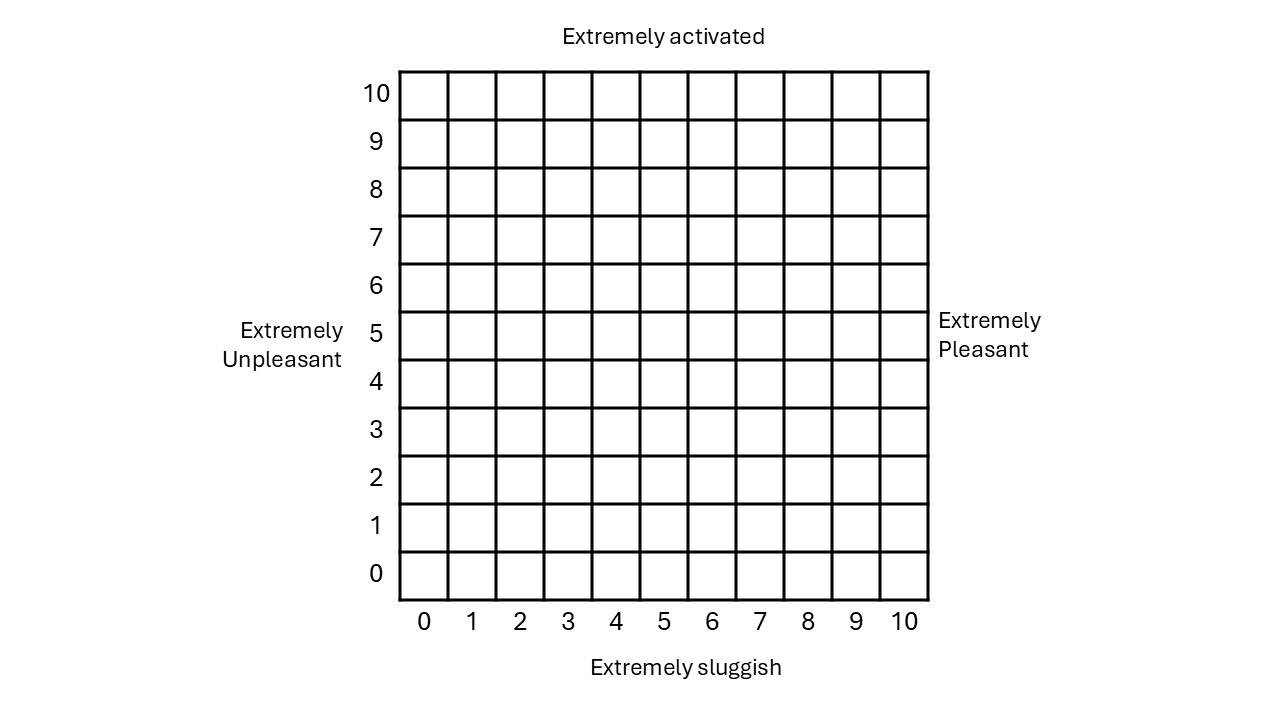
Affect Grid
Rate your current feeling on degree of unpleasantness to degree of pleasantness AND on degree of activation!
What’s nice about the affect grid that you can use it literally any time. Part of being aware is tuning in—where are you landing on pleasantness and activation right now? Ask yourself that question multiple times per day.
The other piece is to start curiously noting when little blips of feelings pop up. For example, I washed my face in the shower the other day, and I had just a tiny blip. I thought, “Huh what is this?” I realized that it was a slight ting of unpleasantness and I realized that it was because my shower face wash isn’t “foaming”—it doesn’t get sudsy. I realized I prefer sudsy soaps, and I felt disappointed briefly. The feeling lasted about 2 seconds, and if I hadn’t been aware, I wouldn’t have clocked it at all.
The idea of Aware is to start paying attention to the smaller little fluctuations in your feelings, because these are more manageable, they are easier to feel, but if we aren’t aware of them, they can build up and get bigger.
B is for Body.
This step is really important because feelings are embodied—they are “created” in the brain, yes, but they are also physical. Emotions are supposed to be felt in the body. For many people who are not used to feeling their feelings, the physical sensations are sometimes noticed but—and this is important—they aren’t correctly linked to the feeling. So if you feel a physical sensation, you can ask yourself if it might be emotional. For example, I tend to feel stress and tension in my stomach, so when I notice that sensation I have to ask myself “Am I hungry? Am I sick? Or….am I anxious?”
Some people live in their heads most of the time and try to ignore sensations from their body. Yet, the body is often trying to tell us something, and that includes emotions too.
When you do have a sensation that might be a feeling, try to curiously locate where that feeling is in your body. Are you experiencing muscle tension? Are you trying to hold back tears from your eyes? Do you feel heavy and droopy? The body sensations often go along with the activation part of the Affect Grid! Noticing where the feeling lives in your body is an important step for feeling the feeling.
L is for Label.
Give the feeling a name. A specific name, ideally, not just “bad” or “stressed.” You can use a list of emotions online if you need help. The Mood Meter or the How We Feel app are designed around the pleasantness-activation model but then provide additional words to choose from. Developing a rich vocabulary of emotion words is an important foundation to being able to label.
This step can take time and practice. If you are aware of a feeling and then notice where it’s living in your body, naming it can be hard if you aren’t used to putting a name on it. You might struggle to decide what word is “right.” There isn’t a specific right or wrong—what word feels like it fits your experience? That’s the right word for you.
The reason why naming the feeling is so important is that naming the feeling helps your brain process the feeling. Naming it tells your brain “Ah yes, THIS feeling” and then the brain stops struggling to figure out what’s going on.
E is for Explore.
Explore in this case means to curiously examine what the feeling is trying to tell you. Naming is an important pre-requisite for the Explore step, because naming a specific feeling will help clue you in to what the emotion wants to say. Emotions come in families, so if you can at least figure out the family you might get a sense of what the feeling is trying to tell you. For example, sadness means a loss or a lack so Exploring is asking “What have I lost? What do I wish I had but I don’t have?” Anger means something is unfair or unjust. You can ask yourself “What is unfair?? Anxiety and fear are about noticing a threat, something potentially dangerous going on right now (Fear) or in the future (Anxiety). You can ask “What is threatening or dangerous?” Exploring means letting your mind consider the answers to these questions and then just allowing those answers to settle into your body.
If you do those four steps, you’ll be ABLE to feel your feelings.
Want an even more fun way to remember this acronym? I wrote the lyrics to a pop song and had suno.ai generate the music to it. Download the song here. I also made a video with my kids! Everyone can be ABLE to feel their feelings if they follow these steps and practice!!!